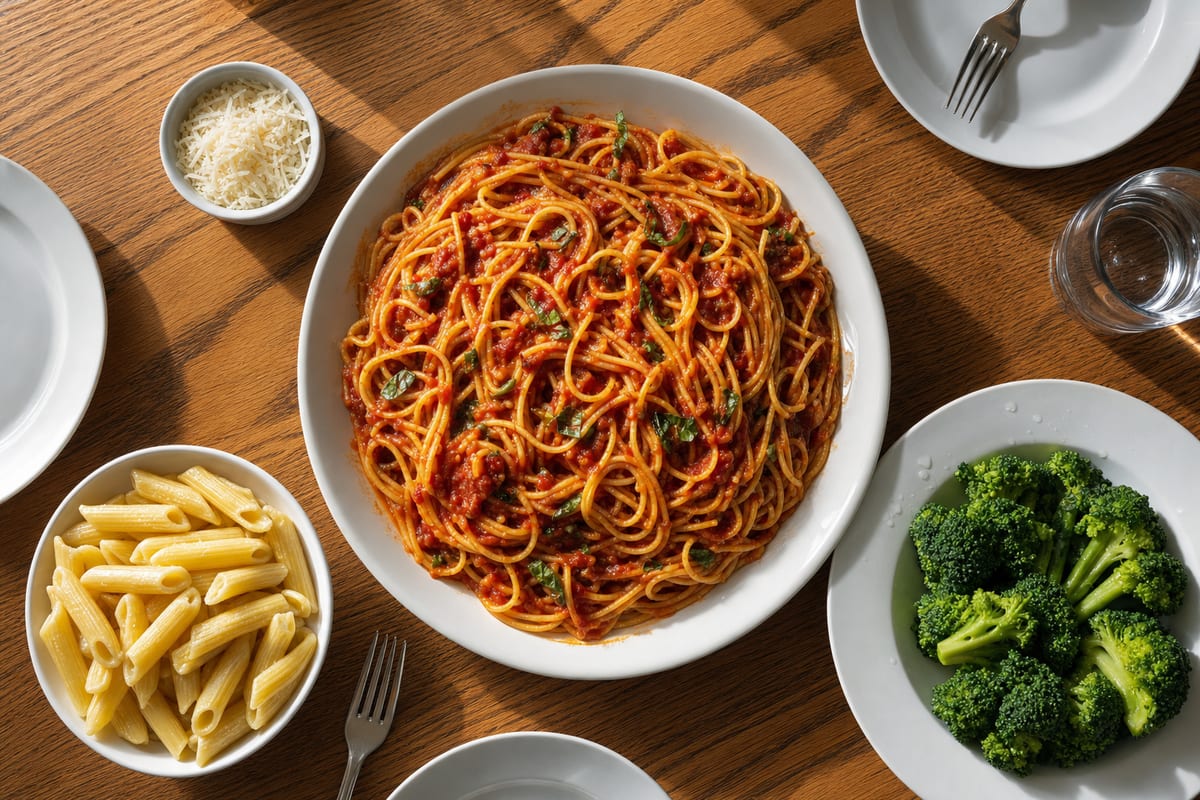
The simplest pasta in the world. Five ingredients — tomatoes, garlic, basil, olive oil, salt — turned into a sauce so good it has been the heart of Italian home cooking for centuries.
Ingredients
- 28 ozcanned whole peeled tomatoes, preferably San Marzano
- 5 tbspunsalted butter
- 1yellow onion, peeled and halved
- 1 tspkosher salt, plus more for pasta water
- 1 lbspaghetti
- ½ cupfresh basil leaves, torn
- 2 tbspolive oil, good quality, to finish
- Parmigiano-Reggiano, freshly grated, optional, to serve
- 1
Pour the whole peeled tomatoes with their juice into a wide saucepan. Use your hands or a wooden spoon to crush them into rough pieces.
- 2
Add the butter, halved onion, and 1 teaspoon of salt. Bring to a simmer over medium heat, then reduce to medium-low.
- 3
Cook uncovered for 30–40 minutes, stirring occasionally and crushing any large tomato pieces against the side of the pan. The sauce is ready when it is thick, glossy, and a wooden spoon leaves a clear trail across the bottom of the pan. Remove and discard the onion halves.
- 4
Meanwhile, bring a large pot of heavily salted water to a boil. The water should taste like the sea. Add the spaghetti and cook 2 minutes less than the package directions.
- 5
Just before draining, scoop out 1 cup of starchy pasta water. Use tongs to transfer the spaghetti directly to the saucepan with the sauce. Add ¼ cup of pasta water.
- 6
Toss vigorously over medium heat for 90 seconds, adding more pasta water as needed, until the sauce coats every strand and the pasta is glossy and finished. The sauce should look slightly creamy from the emulsion.
- 7
Remove from heat. Tear in the fresh basil leaves and stir once. Drizzle with the finishing olive oil.
- 8
Serve immediately on warm plates with Parmigiano on the side.
Nutrition
Per serving · estimated
- Protein18 g12%
- Carbs96 g62%
- Fat18 g26%
More detail
- Fiber6 g
- Sugar12 g
- Saturated fat11 g
- Cholesterol38 mg
- Sodium720 mg
Nutrition values are estimates based on standard ingredient databases. Actual values may vary depending on brands, substitutions, and serving sizes.
Spaghetti pomodoro is the truth-test of a pasta cook. With five ingredients there is nowhere to hide. Bad tomatoes show. Burnt garlic shows. Soggy pasta shows. Stale basil shows. When it is right, it is one of the most satisfying meals in the world.
This is the Marcella Hazan school of thought, slightly modernized. No cream, no cheese in the sauce, no sugar to mask bad tomatoes. Just whole peeled tomatoes, a halved onion (yes, an onion — and you remove it before serving), butter, salt, and patience. A handful of basil at the end.
The tomatoes are the recipe
Use a good can of San Marzano whole peeled tomatoes if you can find them. If not, any reputable brand of whole peeled tomatoes will do. Avoid pre-crushed or pre-diced — they have less control over their own destiny, and the flavor is flatter.
In summer, fresh ripe tomatoes blanched and peeled work beautifully. The rest of the year, canned is honestly better.
The onion trick
Marcella Hazan's contribution: split a yellow onion in half and drop both halves into the simmering sauce. They flavor the sauce gently as it reduces, and you fish them out at the end. The result is sweetness and depth without onion pieces that compete with the tomatoes.
Some traditional recipes use a clove of garlic the same way — bruised, simmered whole, removed at the end. Either approach works. Both is too much.
Cook the pasta in the sauce
A trick that elevates this dish from "good" to "great": once the sauce is reduced and ready, cook the spaghetti two minutes less than the package says, then transfer it directly into the sauce with tongs. Add a splash of pasta water. Toss vigorously over medium heat for the last 90 seconds.
The pasta finishes cooking in the sauce, absorbing flavor, and the starch released from the noodles thickens the sauce into a glossy coat that clings to every strand. This is restaurant pasta technique.
Basil at the end
Tear basil leaves with your hands, not a knife. The leaves bruise less and stay greener that way. Add the basil after the heat is off — it is more aromatic raw than cooked.
What not to do
Do not add sugar. If the tomatoes are sour, a small pinch of salt or a longer simmer will fix it. Do not add herbs other than basil. Do not add cream. Do not "deepen the flavor" with stock. The discipline of doing nothing is the recipe.